How AI Identifies Emerging Research Areas in Collaboration
AI analyzes papers, patents, and grants to spot emerging research fields, collaboration signals, and forecast trends while human oversight helps reduce bias.

How AI Identifies Emerging Research Areas in Collaboration
AI is transforming how research opportunities are identified, helping organizations navigate the overwhelming volume of academic work and funding data. By analyzing millions of papers, patents, and grants, AI tools like Innovation Lens and systems like NIH's RCDC pinpoint emerging research areas and collaboration opportunities faster than humans ever could. Here's how:
- Data Processing Power: AI analyzes vast datasets, uncovering patterns and trends in research that are often missed manually.
- Emerging Field Indicators: Rapid growth (8%+ annual increase), recent references in papers, and interdisciplinary intersections signal new research areas.
- Collaboration Signals: Co-authorship growth, patent-to-paper citations, and university startups highlight areas with high potential for partnerships.
- Trend Forecasting: Tools like Impact4Cast use advanced models to predict impactful research and collaborations years ahead.
AI reduces time and cost barriers, accelerates innovation, and helps institutions prioritize impactful research. However, human oversight remains critical to address biases and validate findings. By combining AI's analytical capabilities with human expertise, organizations can better navigate the complex research landscape.
How AI Reveals Hidden Gaps in Research
Key Signals for Identifying New Research Areas
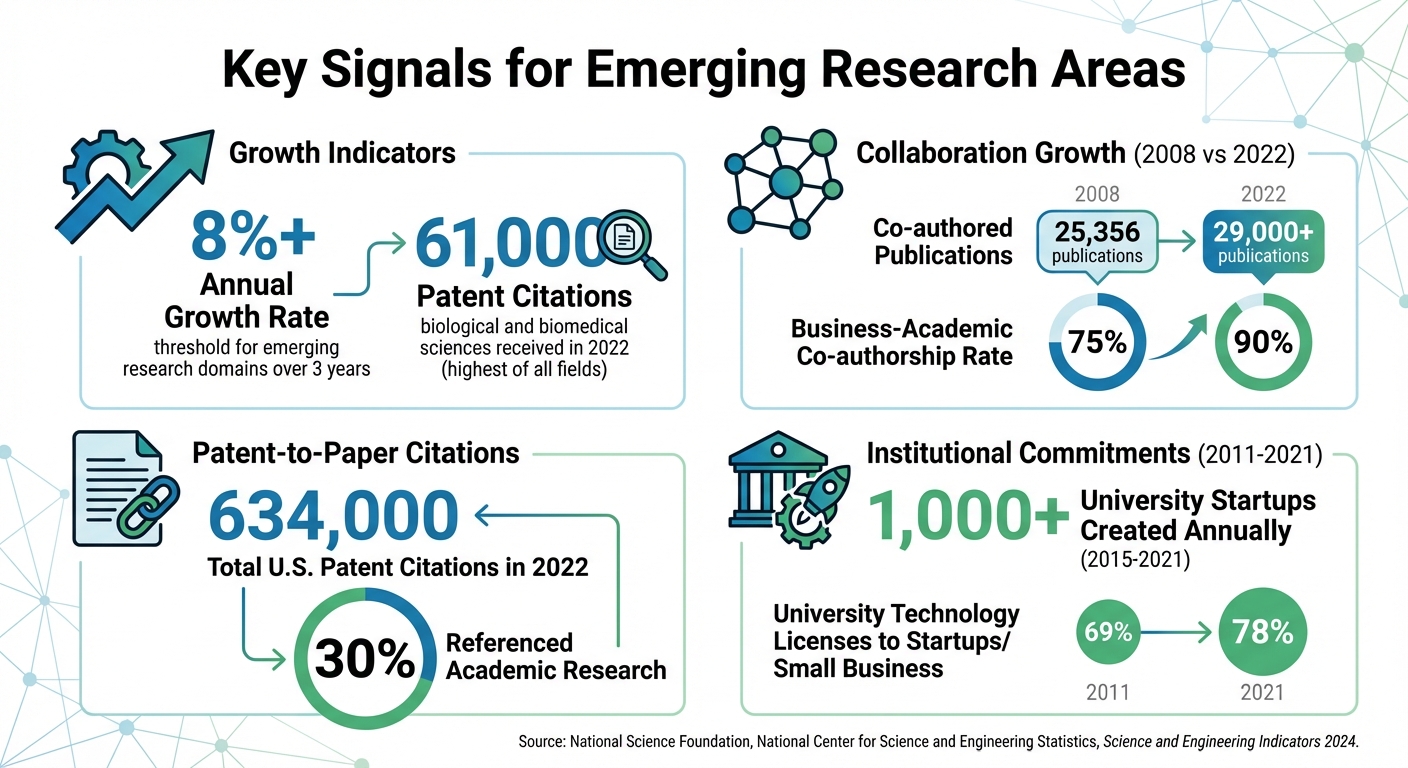
Key Statistics: AI-Driven Research Collaboration Growth 2008-2022
What Makes a Research Area Emerging?
AI has become adept at spotting patterns that separate genuine advancements from passing trends. One of the most telling signs? Rapid growth. A research domain with a compound annual growth rate exceeding 8% over three years is flagged as emerging [9]. But speed alone doesn’t tell the whole story. AI also measures something called "vitality." This involves tracking the average age of references in new academic papers. When researchers begin citing very recent studies instead of older ones, it’s a clear sign that fresh ideas are reshaping the field [9].
Another key indicator is interdisciplinarity - when a research area spans multiple scientific fields, creating entirely new intersections of knowledge [2]. AI maps how topics evolve, merge, and split across the 254 subject categories in databases like Web of Science to uncover these cross-disciplinary connections. For instance, biological and biomedical sciences received 61,000 patent citations in 2022 - more than any other field - because they effectively combine insights from chemistry, engineering, and computer science [6]. These collaborative intersections often mark the birth of dynamic new research fields.
Signals Specific to Collaboration
Collaboration brings its own set of signals that help identify emerging research domains. One of the clearest markers is the rise in co-authorship. For example, U.S. business authors worked with academic institutions on over 29,000 publications in 2022, up from 25,356 in 2008 [6]. The percentage of co-authored business publications also grew significantly, jumping from 75% in 2008 to 90% in 2022 [6].
Another powerful indicator is patent-to-paper citations. These citations - where patents reference academic research - accounted for 30% of the 634,000 U.S. patent citations in 2022. This connection between academic work and commercial innovation highlights which research areas are making the leap from theory to practical application [1][6][8].
AI also tracks institutional commitments, such as Cooperative Research and Development Agreements (CRADAs) and university-licensed startups. Between 2015 and 2021, over 1,000 startups were created annually to develop university-licensed technologies [6]. By 2021, startups and small businesses made up 78% of new university technology licenses - up from 69% in 2011 [6]. These agreements are strong indicators of long-term commercial potential in emerging research areas.
AI Techniques for Detecting Trends in Collaborative Research
Topic Modeling and Research Clustering
AI leverages techniques like Latent Dirichlet Allocation (LDA) to sift through enormous collections of documents, uncovering hidden themes within scientific literature [7][11]. This unsupervised method digs beneath the surface of language, identifying patterns that point to distinct scientific fields.
Once these themes are identified, AI takes it a step further by clustering research papers through citation analysis. Algorithms such as VOS and Leiden group these papers into research communities (RCs) [9]. As Richard Klavans explains:
"The type of document clusters that are created using this approach have been shown to represent the way researchers actually organize around research problems" [9].
After forming these clusters, AI models their growth using metrics like compound annual growth rates or first-order rate kinetics [7][9]. These frameworks link collaboration networks with knowledge domains, giving researchers a way to predict where technological convergence might happen next [10]. By employing these clustering techniques, AI sets the stage for forecasting the future impact of emerging research areas.
Trend Analytics and Growth Forecasting
AI doesn't stop at identifying trends - it also predicts which research fields are likely to make the biggest impact in the future. Transformer-based models, for example, have been shown to improve forecasting accuracy by about 15% over recurrent neural networks (RNNs) and outperform static machine learning models by more than 25%. These models excel at capturing the dynamic nature of evolving research trends [10].
One standout example is "Impact4Cast", a tool developed in April 2023 by the Max Planck Institute for the Science of Light. By analyzing a knowledge graph built from 21 million papers, this AI system uncovered a high-risk, high-impact connection between "renewable energy" and "cancer cell" research. It also predicted high-impact collaborations with an AUC (Area Under the Curve) score exceeding 0.9 for identifying highly cited research three years into the future [12].
AI also helps distinguish between sheer publication volume and genuine knowledge growth. A study analyzing 213 million publications found that while the number of papers grows exponentially, actual knowledge expands at a linear rate. Strikingly, 90.73% of scientific knowledge comes from just 9.27% of research efforts [13]. As Huquan Kang from Shanghai Jiao Tong University puts it:
"Producing knowledge is far more challenging than producing papers" [13].
This clarity allows institutions to prioritize groundbreaking research over simply chasing publication numbers. By combining advanced forecasting with clustering, AI offers a comprehensive perspective that strengthens strategic collaboration efforts.
Network Analysis of Collaborative Structures
AI also excels at mapping collaboration networks to uncover emerging partnerships. By analyzing dual networks - those that track both collaborative relationships and technological convergence - AI can forecast new trends [10].
Link prediction algorithms play a key role here. These algorithms identify "missing links", or potential partnerships that haven't yet formed but are likely to succeed based on shared research interests and institutional strengths [11]. Yan Qi from the Chinese Academy of Medical Sciences highlights the importance of this:
"Selecting the right collaboration partner is one of the most important contributors to success in collaborative innovation" [11].
AI also ranks organizations by their research output (capability) and their history of external collaboration (openness) [11]. The predictive accuracy of these methods is impressive. For instance, a study of over one million forecasts found that AI could predict exceptional research growth - defined as an annual publication share increase of more than 8% - with a Critical Success Index (CSI) of 25%, a benchmark similar to that used in weather forecasting [9].
Platforms like Innovation Lens harness these AI-driven insights to guide deeptech investors, research institutions, and grantmakers. By identifying high-potential, underexplored research areas, these tools help stakeholders make smarter, more strategic decisions.
sbb-itb-5766a5d
Practical Steps for Using AI to Identify New Research Areas
Defining Your Priorities
Start by outlining your organization's strategic goals. Create a "digital fingerprint" that captures the essence of these priorities - this could include keywords, themes, or examples from past successful projects [4]. This step ensures that AI tools are aligned with your mission, making it easier to sift through the massive research landscape for insights that matter most.
Organize research areas based on their activity levels and growth rates. This approach helps distinguish between emerging fields (low activity but fast growth) and "hot" areas (high activity and rapid growth) [15]. To maintain consistency and interoperability across sectors, align your AI tools with open-source taxonomies like the UN Sustainable Development Goals [15].
Once priorities are established, leverage AI-driven scans to explore the research landscape efficiently.
Conducting AI-Driven Landscape Scans
AI can streamline what would otherwise be an overwhelming task: analyzing data from publications, patents, and grant applications. Manually reviewing funded awards is simply too time-intensive [4]. AI, however, can process this information quickly and effectively.
Start by identifying papers authored by your organization and use AI tools to map them onto global "Maps of Science" [5]. From there, use citation joins to connect academic research with patent activity, revealing potential industry impacts [1]. Additionally, analyzing rejected grant applications - often numbering 4–12 for every funded award - can highlight underexplored opportunities or areas where scientific progress is lagging [4].
Once the landscape is mapped, rank emerging domains systematically based on their relevance and potential impact.
Evaluating and Prioritizing New Domains
A structured ranking system is key to identifying the most promising areas. For example, the NIH's "Matchmaker" tool allows researchers to input proposal text and receive a list of similar funded projects. This tool uses semantic analysis, not just keyword matching, to ensure alignment with your defined priorities [4].
An example of AI's potential is Google Research's "AI co-scientist" system, built on Gemini 2.0. By running multi-agent simulations, it identified novel drug repurposing candidates that were later validated in lab settings [14]. This showcases how AI can uncover transformative opportunities that align with strategic goals.
Platforms like Innovation Lens also use predictive analytics to help deeptech investors and research institutions evaluate and prioritize promising projects. By combining curated reports with algorithm-driven insights, these platforms focus attention on high-potential, underexplored areas, making the prioritization process both strategic and actionable.
Ethical and Transparent Use of AI in Research Trend Detection
Addressing Bias in AI-Driven Insights
AI systems often reflect and amplify biases present in their training data, which can distort the identification of research trends. For example, if a dataset disproportionately represents certain institutions, disciplines, or demographics, the AI is likely to favor those patterns when highlighting emerging areas.
In December 2024, researchers at the Massachusetts Institute of Technology (MIT) introduced a technique called Data Debiasing with Datamodels (D3M) to address this issue. Led by graduate student Kimia Hamidieh and Professor Marzyeh Ghassemi, the team utilized the TRAK method to identify specific training examples responsible for failures affecting underrepresented groups. Their approach was tested on three machine-learning datasets and showed promising results: it improved accuracy for minority subgroups while requiring the removal of roughly 20,000 fewer training samples compared to traditional data-balancing methods [16].
"There are specific points in our dataset that are contributing to this bias, and we can find those data points, remove them, and get better performance."
– Kimia Hamidieh, Graduate Student, MIT [16]
To ensure fairness in AI-driven research, it's crucial to regularly audit training datasets for diversity and representation. Tools like TRAK can help pinpoint biased data points [28, 30]. Additionally, examining both successful and unsuccessful research proposals can uncover areas that traditional funding structures might be neglecting [4]. When real-world data is insufficient for certain demographics or research areas, synthetic data can be a useful supplement [17].
Bias mitigation should occur at every stage - pre-processing, algorithmic, and post-processing [17]. Building diverse teams for AI development also enhances bias detection and correction [17].
Ultimately, while reducing bias is critical, combining human expertise with AI ensures better decision-making overall.
Balancing Human and AI Decision-Making
Once bias in AI outputs is addressed, the next step is to integrate AI's capabilities with human judgment. While AI excels at processing large volumes of data, it lacks the intuition and contextual understanding that humans bring to the table. A balanced workflow allows each to contribute their strengths.
In December 2024, the Center for Security and Emerging Technology (CSET) proposed a human-machine teaming approach. Using the "Map of Science" to identify research clusters based on citation patterns, AI handles the data analysis, while subject-matter experts assess the clusters for strategic importance and impact [5]. This partnership ensures that AI performs the heavy lifting, but humans make the final decisions on which trends are most relevant.
| Aspect | Human Judgment | AI-Augmented Decision-Making |
|---|---|---|
| Strength | Deep understanding of emotions, motivations, and context [18] | Processes massive datasets and uncovers non-obvious patterns [32, 33] |
| Limitation | Limited by cognitive capacity and speed [19] | Lacks intuition and struggles to explain the "why" behind trends [18] |
| Error Profile | Prone to subjective biases [20] | Susceptible to systemic bias and occasional "hallucinations" [19] |
Human oversight is essential for validating AI-generated insights. AI cannot replace human authorship or take responsibility for published work [37, 38]. As Nikki Mehrpoo from AIHI and AIWC puts it:
"If AI plays any role in a decision about a person, human oversight must be part of that process. That is not optional. It is part of professional duty." [21]
It's also critical to verify AI-generated citations and claims. For instance, a study revealed that 47% of medical references produced by ChatGPT 3.5 were completely fabricated [19]. Protect sensitive research data by avoiding uploads to public AI tools, which could lead to privacy breaches or loss of intellectual property [37, 39]. To ensure reproducibility, keep detailed logs of all AI-driven data processing and trend mapping [22].
Conclusion and Measuring Success
Key Takeaways
AI is reshaping how we approach research discovery by handling massive datasets in real time - something manual methods simply can't achieve at scale. For example, reviewing thousands of federal research awards manually would be nearly impossible, but AI processes this information instantly, uncovering insights that traditional methods might miss[4].
One standout strength of AI is its ability to identify untapped commercial opportunities. In 2024, a pilot project at Northwestern University demonstrated this potential when AI analyzed a biology researcher’s work. It revealed numerous patent citations by private companies, even though she had no prior interaction with a Technology Transfer Office. Within just a week, she filed her first invention disclosure[3]. Stories like this highlight how AI streamlines research discovery and accelerates innovation commercialization.
AI also brings objectivity to decisions about funding and partnerships. Systems like the NIH's RCDC leverage text-mining to deliver faster, more efficient results[4]. Machine learning models further enhance collaboration by predicting areas where knowledge domains are likely to intersect. These models have improved accuracy in identifying collaboration partners by 15%[10].
Metrics for Success
To measure AI's impact, start with tangible outcomes. For instance, calculate how much staff time is saved by automating tasks like literature reviews or grant application evaluations[4].
Another critical metric is the time it takes to move from AI detection to broader adoption. Track the growth in collaborative outputs, such as co-authored papers and patents between academic and industry partners[10]. Knowledge transfer metrics are equally important - monitor patent citations, invention disclosures, and the formation of university-affiliated startups. In 2022, U.S. academic institutions accounted for about 30% of the 634,000 citations to science and engineering articles in patents[8].
Time-to-translation is another valuable indicator. This measures how quickly research progresses from publication to practical applications like patent citations or clinical trials[3]. You can also validate your AI models by backtesting them with historical data from the past 5–10 years to see if they would have accurately identified today’s high-growth research areas[4]. By consistently tracking these metrics, organizations can refine and improve their AI-driven strategies for advancing collaborative research.
FAQs
How does AI identify emerging research areas and differentiate them from short-lived trends?
AI pinpoints emerging research areas by analyzing consistent growth patterns in data rather than being swayed by short-lived trends. Machine learning models are trained on vast datasets of research papers and patents to identify early signs of promising work. These signs include the appearance of new keywords, cross-disciplinary references, and steady increases in citations over time.
To refine these insights, advanced AI tools leverage bibliometric techniques. These methods score terms based on factors like citation bursts, rising term frequencies, and their importance within research networks. This approach helps separate lasting developments from passing fads. Expert evaluations further validate these findings, ensuring the highlighted areas represent genuine momentum rather than temporary popularity.
By blending predictive modeling, bibliometric analysis, and expert judgment, AI provides a reliable way to identify research areas with the potential to drive lasting innovation and progress.
Why is interdisciplinarity important in identifying new research areas?
Interdisciplinary approaches play a crucial role in identifying new research areas by merging insights, methods, and data from different fields. This blend of perspectives opens doors to fresh opportunities. For example, combining materials science with machine learning can reveal unique patterns and trends that AI tools can analyze, paving the way for predicting untapped possibilities.
AI excels when fed with interdisciplinary data, as it can connect the dots between publications, patents, and grants from various domains. Tools like Innovation Lens leverage this capability to spotlight overlooked research areas with high potential. This helps both industry and academia channel their efforts toward transformative discoveries that might otherwise remain hidden.
How can organizations use AI ethically to identify emerging research trends?
To promote the ethical use of AI in identifying research trends, organizations need to implement a strong AI governance framework. This means setting clear policies around transparency (like documenting where data comes from and explaining why certain topics are flagged), bias prevention (such as testing models to ensure fairness across different fields and demographic groups), and data privacy compliance (including following consent guidelines and data retention rules). It's also crucial to establish accountability - assign specific individuals to oversee AI outcomes and maintain detailed audit trails. On top of that, human oversight should play a role in reviewing AI-generated insights before making any big decisions.
In practice, this can involve creating ethics committees, performing regular risk assessments, and using monitoring tools to keep an eye on fairness and explainability metrics. For example, when working with platforms like Innovation Lens to identify promising research areas, it's essential to configure analytics in line with these ethical guidelines. This ensures the insights are not only trustworthy but also reflect the organization's core values.